Your Cat Has Outgrown Everything — You Just Haven't Noticed Yet
You don't see a cat grow the way you see a child grow. There's no height chart, no clothes that stop fitting. Then one day you really look — and your Maine Coon has been folded into a bed built for a 9 lb cat for months. The scratching post ends at its chest. The cat tree wobbles every time it jumps. It's been like this for a while.
Large cat breeds grow slowly and continuously for three to four years. A Maine Coon or Ragdoll at eight months looks big. At eighteen months it looks like a bigger version of that. At three years it's a completely different animal in terms of weight, length, and the physical demands it places on everything it uses. And you bought most of that equipment when it was eight months old.
The problem is gradual and invisible. The scratching post wobbles a little more each week. The sleeping platform that once fit comfortably becomes one where two paws hang off. The cat tree that was stable at 14 months isn't stable at 28. None of it announces itself. It just quietly stops working — while the cat quietly adapts, and the sofa quietly pays the price.
What "Too Small" Looks Like in Real Life
Because cats don't announce they've outgrown something, you have to know the signs. These are the three most common — the ones people walk past every day without registering as a problem.
The cat isn't lying flat — it's compressed. Paws folded under, tail wrapped tight, body arranged to fit the container. It looks cozy. Look closer: the cat is making itself small, not resting in a position its body chose. Over months, compromised rest shows up as less play engagement, more irritability, longer sleep that produces less restoration.
Front paws hit the top while the cat's body is still bent — no room to fully extend. A proper scratch is a full-body movement: arms raised, spine extended, back feet flat. If the post ends before the cat runs out of body, the scratch is incomplete. The cat will briefly use the post and move on to something taller — usually your door frame or the arm of your sofa.
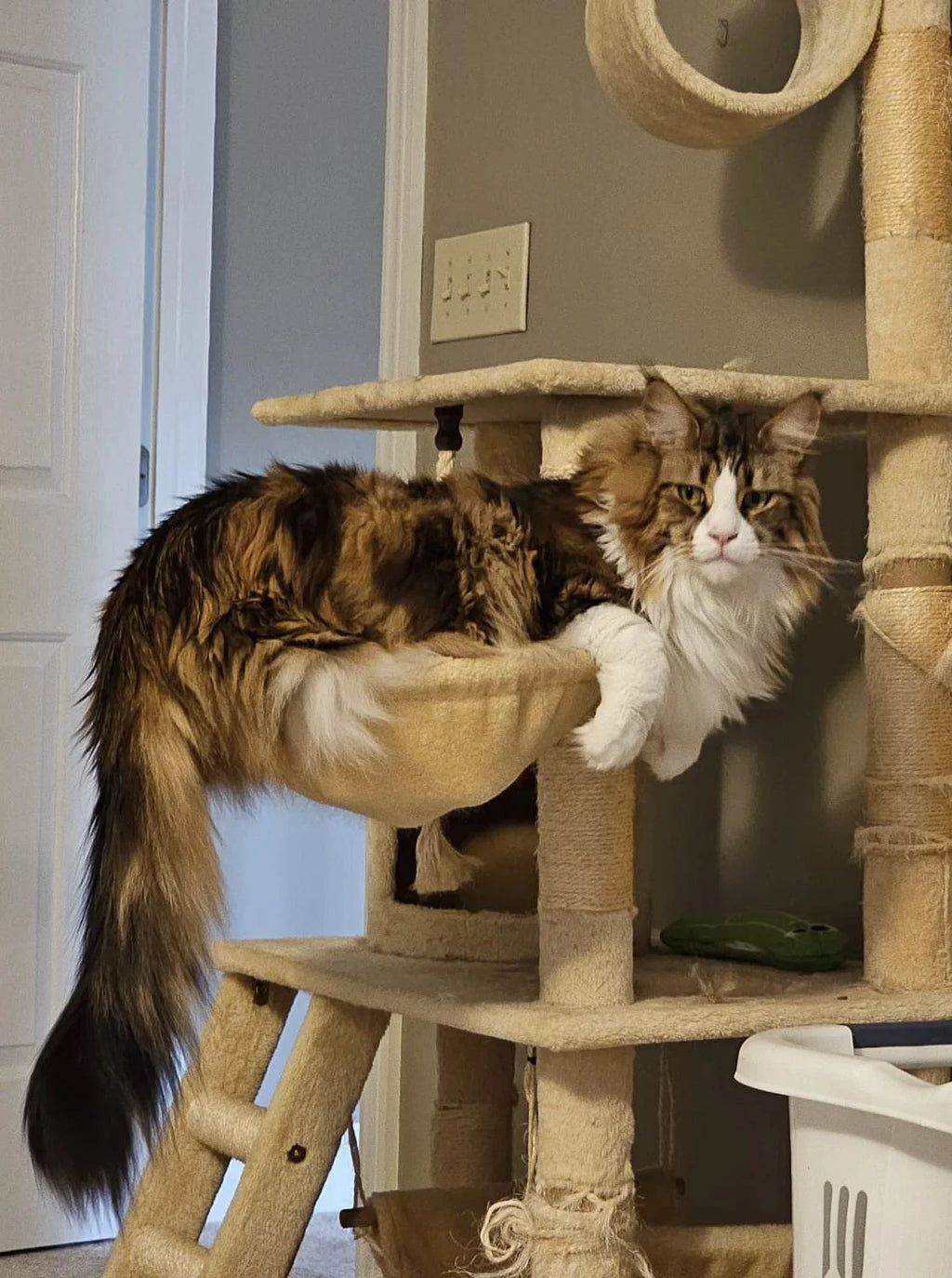
Two paws on the surface, two hanging off. Tail draped over the edge. The cat is using the platform because it's elevated — not because it's comfortable. A cat that overhangs its resting platform on more than one side can't rest securely. Over weeks, it migrates back to the floor or the sofa, which at least offer enough surface area.
Maine Coons grow until they're 3 to 4 years old — one of the longest growth periods of any domestic cat breed. A Maine Coon at 18 months may weigh 12–14 lbs. The same cat at 36 months may weigh 18–22 lbs. That's nearly double the load on every platform, post, and piece of furniture it uses daily. Equipment appropriate for the 18-month cat is often structurally inadequate for the 3-year cat — and the transition happens so gradually that most owners never connect the dots.
The Behavioral Signals You're Probably Missing
When equipment stops working, cats don't complain — they adapt. And the adaptations are easy to misread as personality or mood rather than what they actually are: a cat working around a problem that doesn't need to exist.
-
Stopped using the cat tree A cat that loved its cat tree and gradually stopped isn't bored with vertical space — it's lost confidence in a structure that no longer feels stable under its weight. Instinct overrides habit: an unstable perch is a threat, no matter how familiar.
-
More furniture scratching Increased furniture scratching in a previously well-behaved cat almost always means the scratching post no longer satisfies — too short for a full extension scratch, too wobbly to pull against, or the sisal too worn to provide the right resistance.
-
Sleeping on the floor or sofa A cat that increasingly chooses flat surfaces over its designated sleeping spot may be choosing surface area over territory — because the bed or platform no longer accommodates its full body length comfortably.
-
Ignoring toys completely Toys that once required effort become instantly catchable as a cat grows. A toy that needs no effort produces no engagement. A cat lying next to an untouched toy isn't lazy — it's under-stimulated by equipment that no longer matches its physical capability.
"I bought everything when she was a kitten. By the time she was two, the cat tree was basically furniture she walked past. I thought she'd just lost interest. Turns out she'd outgrown it."
The Growth Timeline You Need to Know
Different large breeds grow at different rates. Use this as your reference — and your reminder to re-evaluate equipment before the cat misbehaves, not after.
| Age | Maine Coon | Ragdoll | Equipment check |
|---|---|---|---|
| 3–6 months | 4–7 lbs · fast growth | 4–6 lbs · fast growth | Kitten equipment appropriate |
| 6–12 months | 8–12 lbs · rapid growth | 7–10 lbs · rapid growth | ⚠ First upgrade checkpoint |
| 12–18 months | 10–15 lbs · slowing | 10–14 lbs · slowing | ⚠ Check cat tree stability |
| 18–36 months | 14–20 lbs · still growing | 12–18 lbs · still growing | ⚠ Most owners miss this one |
| 3+ years | 18–25 lbs · full adult | 15–20 lbs · full adult | Size for full adult weight — for life |
Once a year on your cat's birthday, run a ten-minute equipment audit. Place the cat in its bed — does it fit flat with room to extend? Have it scratch the post — can it fully extend without hitting the top? Put it on the cat tree platform — does its full body fit with nothing overhanging? Does the tree move at all when it scratches hard?
Ten minutes, once a year. That's the difference between catching a problem at month 14 and living with it until month 26.
Category by Category: What to Check
Cat tree & scratching post
The most important piece to size correctly, and the most commonly undersized. The post must be tall enough for a full upright extension — for a Maine Coon or Ragdoll, that means at least 35 inches. The platform must be wide enough for the cat to lie flat (minimum 16 × 16 inches for most adult large breeds). The base must stay completely planted under the full pulling force of a 20+ lb cat scratching hard.
A tree that passed the stability test at 14 months may fail it at 30 — because the cat is now 6 lbs heavier. This is the checkpoint most owners miss entirely. They remember to upgrade when the cat is young and growing visibly fast. They forget to re-evaluate once it reaches its adult size — which happens late and slowly in large breeds.
Sleeping surfaces
Measure your cat nose to tail base — that's the minimum interior length of any sleeping surface allowing genuine flat rest. Most adult Maine Coons and Ragdolls need at least 20–24 inches of interior sleeping space. Most standard cat beds are 18–22 inches in total diameter, with a smaller interior. The math isn't complicated, and neither is the fix.
Toys
A wand toy that was hard to catch at 5 months is trivially easy at 2 years. Large adult cats need toys that match their physical capability: heavier wand heads, faster movement, puzzle feeders with more complex mechanisms. A cat that appears uninterested in play is usually a cat whose toys stopped being interesting — not a cat that stopped wanting to play.
You Don't Always Need a New Tree — Sometimes Just a Bigger Platform
At Cat Tree King, every structural component is available individually. If your cat has outgrown the platform but the frame is still solid, replace just the platform. Worn sisal? Swap the post. Need a larger sleeping box? Order one. Upgrade what's no longer working without replacing everything.
The Full Annual Checklist
- Cat can't lie fully flat in its bed — body compressed, paws or tail hanging off
- Scratching post top is reachable mid-scratch with body still bent — no full extension
- Cat tree platform overhangs on more than one side when the cat rests on it
- Cat tree moves or sways when the cat climbs to the top or scratches hard
- Sisal is shredded flat — no longer provides tactile resistance
- Cat has stopped using the cat tree it previously used every day
- Furniture scratching has increased or restarted after a long quiet period
- Toys are ignored immediately — no engagement even with rotated options
- Cat lies fully flat on sleeping surface — full body supported, tail included
- Full upright extension achieved during scratch — arms raised, spine extended, back feet flat
- Cat tree platform supports the full body with no overhanging limbs
- Cat tree doesn't move at all under the cat's full weight
- Cat uses the tree daily — including the top platform
- Sisal is firm and provides clear resistance — cat visibly engages with it
- Furniture is untouched for extended periods
- Toys require visible effort — cat returns to them across multiple sessions
"My Ragdoll is almost 4 now and weighs about 19 lbs. I realized he hadn't been using his old cat tree for almost a year — I assumed he'd outgrown the interest. Got a CTK corner tree with the wider platforms and he was on it within an hour. Turns out he'd outgrown the tree, not the desire. Platform size was the whole thing — he can actually lie flat now."
Frequently Asked Questions
How do I know if my cat has outgrown its cat tree?
Three things to check: does the tree move at all when you push the post firmly? Can your cat lie fully flat on the platform with no body parts overhanging? When scratching, does your cat hit the top of the post while its body is still bent? If any of these fail, the tree has been outgrown. A cat that has simply stopped using a tree it once used daily is also a strong indicator — this is almost always a stability or size issue, not a loss of interest in vertical space.
When do Maine Coons stop growing?
Maine Coons reach full adult size at 3 to 4 years — significantly later than average domestic cats, which typically stop growing around 12 months. Males usually reach 15–22 lbs, with some individuals reaching 25 lbs. Because growth is so gradual and extended, most owners don't register that their cat is still gaining weight and length from month 18 through month 36 — exactly when equipment that was appropriate at 14 months becomes structurally inadequate.
When do Ragdolls stop growing?
Ragdolls also reach full size at around 3 to 4 years. Males typically reach 15–20 lbs, females 10–15 lbs. Like Maine Coons, their growth is slow and continuous rather than a rapid early burst — which means equipment tends to be quietly outgrown without any obvious moment of transition. The annual check is the most reliable way to stay ahead of it.
My cat stopped using its cat tree. Does it just not like it anymore?
Almost never. Cats don't lose interest in vertical territory — it's a core instinct that doesn't switch off. What changes is their confidence in the specific structure. A tree that wobbles under a heavier cat gets abandoned because instinct overrides habit: an unstable perch is a risk, regardless of familiarity. Push the post firmly — if it moves at all, that's your answer. A stable replacement in the same spot is typically adopted within days.
Do I need to replace the whole cat tree or just upgrade parts?
It depends on what's failed. Worn sisal but solid structure? Replace just the post. Platform too small but frame still stable? Swap the platform for a wider one. Base no longer heavy enough for the cat's full adult weight? The structure needs replacing. At Cat Tree King, all components are available individually — so you can upgrade exactly what's no longer working without starting over.
What size cat bed does an adult Maine Coon or Ragdoll need?
Measure your cat from nose to the base of the tail — that's the minimum interior length of any sleeping surface that allows genuine flat rest. For most adult Maine Coons and Ragdolls, this means a bed with at least 20–24 inches of interior sleeping space. Most standard pet store cat beds have 18–22 inches of total diameter with a smaller interior — adequate for average cats, too small for large breeds to rest without compression.
How tall should a scratching post be for a Maine Coon or Ragdoll?
At minimum 35 inches — and measure your specific cat's full upright reach before buying. Stand the cat gently upright with front paws raised as if scratching, and measure floor to paw tips. That number is your minimum. For large male Maine Coons, this is often 36–40 inches. Any post shorter produces an incomplete scratch, which means the cat will seek a taller surface elsewhere — usually your furniture.
The Bottom Line
Your cat grows slowly, silently, and without flagging the milestones. The bed that fit at eight months is too small at two years. The cat tree that held at fourteen months wobbles at thirty. The post that was perfect as a kitten ends at chest height now. None of this gets announced — and the cat will quietly adapt rather than tell you.
The annual check takes ten minutes. A flat-rest test in the bed. A stability push on the cat tree. A full-extension scratch on the post. If something fails, you often don't need to replace everything — just the piece that no longer works. And at Cat Tree King, that piece is always available on its own.
Built to Grow With Your Cat.
Cat Tree King's modular system means individual components — platforms, sisal posts, sleeping boxes — are all available separately. Start right. Upgrade what needs it. Never replace a whole tree just because one part wore out.
Shop Trees & Replacement Parts →