Bengal Behavior Decoded — What Your Bengal Is Trying to Tell You
Chirping at the window. Sprinting laps at 3 AM. Knocking your glass off the counter. Sitting in the sink. Your Bengal isn't being chaotic — every behavior is a direct line to something specific they need, feel, or are wired to do. Here's exactly how to read them.
Bengals are not difficult cats. They are high-information cats — animals that communicate constantly, intensely, and with remarkable precision, in a language most owners haven't been taught to read. The chirping isn't random. The 3 AM circuit of the living room isn't misbehavior. The counter surfing isn't spite. Each behavior is a signal, and each signal has a source.
Understanding those sources doesn't just explain the behavior. It tells you exactly what your Bengal needs — and what kind of environment gives them somewhere to put all that energy, intelligence, and instinct. This guide decodes the four most iconic Bengal behaviors one by one, translating what your cat is actually saying and what the appropriate response looks like.
Why Bengals Behave the Way They Do
Every Bengal behavior makes perfect sense once you understand where Bengals come from. The breed was developed through crosses between domestic cats and the Asian Leopard Cat (Prionailurus bengalensis) — a small, intensely athletic wild cat native to South and Southeast Asia. The goal was to create a cat with the domestic temperament but the dramatic spotted coat of its wild ancestor.
What breeders got was considerably more than a coat. The Asian Leopard Cat is a solitary hunter that patrols large territories, hunts near water, climbs expertly, vocalizes specifically during prey interaction, and is active in extended dawn-and-dusk bursts. Strip away the genetics and you have a precise blueprint for the behaviors Bengal owners encounter every day.
Asian Leopard Cat
The wild ancestor. Small, solitary, intensely athletic. Hunts near streams, climbs high, patrols wide territory at dawn and dusk.
What transferred
Prey-tracking vocalizations, water affinity, extreme vertical drive, crepuscular activity peaks, and high cognitive demand.
What it means indoors
A domestic cat running wild software in a home environment — and communicating loudly when that environment can't keep up.
F4 and later-generation Bengals — the ones typically sold as pets — are considered fully domesticated. But "domesticated" does not mean "instinct-free." The behavioral DNA of the Asian Leopard Cat persists robustly into F4 and F5 generations. A Bengal that has never seen a stream or a live bird still carries the neural architecture of an animal that evolved to hunt near water and chase fast-moving prey through three-dimensional terrain.
Behavior #1: The Chirp
You're sitting at the window with your Bengal when a bird lands outside. Your cat goes absolutely still — tail low, pupils dilated, every muscle locked — and then produces a rapid, staccato sound that's somewhere between a chirp, a click, and a teeth-chattering stutter. It's one of the most distinctive sounds in the cat world, and it's almost impossible not to anthropomorphize it as frustration.
The chirp is not frustration. It's not even really a vocalization in the communicative sense. It's a motor pattern — a reflex that fires when the prey-drive circuitry is fully activated but the prey is unreachable. Researchers believe the jaw movement mimics the kill bite — the precise, vertebrae-severing bite a cat delivers to the back of a prey animal's neck. The sound is a byproduct of that jaw movement running without a target to apply to.
Some ethologists also propose a second function: that the sound may originally have served as a lure — mimicking the sounds of prey animals to draw them closer. The Asian Leopard Cat has been observed producing similar sounds near bird roosting sites. Whether lure or reflex, the neural pathway is the same: predator sees prey, predator cannot reach prey, predator's motor system fires anyway.
Bengals chirp more intensely than most domestic breeds because their prey drive is more intense. The same stimulus that produces a brief tail-flick in a tabby produces full-body predatory lock-on in a Bengal. This is not a problem to solve — it's a feature. The chirp is your Bengal showing you exactly how alive and engaged they are.
What matters is what happens after the chirp. A Bengal that chirps and then has somewhere to discharge that activated energy — a wand toy session, a climbing structure to sprint up, something to hunt — returns to baseline quickly. A Bengal that chirps and has nowhere to go with the energy becomes increasingly restless, vocal, and disruptive over the course of the day.
- Position a cat tree or perch directly at the window where the chirping happens — your Bengal needs a launching pad, even for birds they can never reach
- Follow a chirping session with 10–15 minutes of wand toy play — redirect the activated prey drive immediately while it's hot
- Use feather wands and toys that mimic bird movement: erratic, fast, airborne — this is what the chirp system was built for
- Consider a bird feeder outside the Bengal's main window — controlled, safe prey stimulus that provides enrichment daily without frustration escalating
Behavior #2: The 3 AM Zoomies
At 3 AM, your Bengal launches off your bed, sprints down the hallway, vaults onto the highest surface in the room, descends in three moves, and circles back to do it again. It sounds like controlled chaos. It is actually highly structured, purposeful athletic behavior — and it happens at 3 AM for a specific reason.
The Asian Leopard Cat is crepuscular — most active at dawn and dusk, with a secondary activity peak in the small hours of the night. Domestic cats have partially adapted to human schedules, but Bengals retain a much stronger crepuscular drive than average domestic breeds. When your Bengal zoomies at 3 AM, they are running on a biological clock that has been calibrated over thousands of years to say: this is when prey is moving; this is when we hunt.
But there's a second factor that determines whether the 3 AM drive expresses as a brief sprint or a 45-minute demolition of the house: how much physical and cognitive discharge happened during the waking hours. A Bengal that has been genuinely tired out — through intense play, climbing, exploration, and problem-solving — has a much quieter night. A Bengal that spent the day on a sofa with nothing to engage has a full tank of unspent energy that the biological clock ignites at 3 AM.
The nighttime zoomies are not disobedience. They are the nighttime energy account being settled — with interest.
The solution is almost never behavioral training, white noise machines, or closing the bedroom door. Those address the symptom. The solution is daytime exhaustion — genuinely tiring your Bengal out through high-intensity play, vertical climbing, and cognitive challenge so that the 3 AM clock fires into a nearly-empty energy account.
- One intense wand play session of 20–30 minutes in the early evening — this is the most important single intervention for nighttime zoomies
- End every play session with a small meal or treat — this completes the hunt-catch-eat cycle and triggers the post-hunt rest response
- A tall cat tree with multiple climbing levels gives your Bengal somewhere to sprint vertically during the day, depleting the energy that would otherwise discharge at 3 AM
- Rotate puzzle feeders and foraging toys throughout the day — cognitive fatigue contributes significantly to nighttime calm
- If 3 AM zoomies persist after 3–4 weeks of consistent evening play, add a second play session in the late afternoon
"Once I understood the 3 AM thing was about daytime energy, everything changed. Twenty minutes of wand play at 9 PM and a small treat after. He sleeps through the night now. Took about ten days."
Behavior #3: Counter Surfing
Your Bengal is on the counter. Then the refrigerator. Then the top of the kitchen cabinets. Then the highest bookshelf in the living room. Then back to the counter to knock your coffee mug precisely one inch toward the edge — making eye contact with you the entire time. This is not random. Every element of this sequence is intentional.
Counter surfing combines two of the Bengal's most powerful drives: vertical territory mapping and investigative intelligence. The Asian Leopard Cat survives by knowing its territory in three dimensions — not just the ground plane but every level of the vertical space, where prey hides, where threats come from, where retreat routes are. Domesticated Bengals apply this same drive to the interior of your home. They don't surf the counter to annoy you. They surf the counter because the counter is the highest accessible horizontal surface in the most active room, and their territorial instinct requires them to own it.
The eye contact while pushing the mug is a separate behavior layered on top: it's attention solicitation. Your Bengal has learned — correctly — that pushing objects off surfaces produces an immediate, reliable human response. This is operant conditioning working exactly as it should, from the cat's perspective. You've reinforced the behavior by reacting to it. The Bengal did not figure this out by accident. They figured it out by testing, observing, and updating their model of how you work.
Punishing counter surfing in a Bengal is largely ineffective because it addresses neither the territorial drive nor the attention need. The Bengal will return when you're not watching, because the drive to map and own high territory doesn't switch off under deterrent pressure — it just routes around the deterrent.
The productive response is to provide better high territory that the Bengal can legitimately own, combined with reliable daily attention that removes the need to demand it through mug-pushing.
- A tall cat tree that reaches or exceeds counter height gives your Bengal a legitimately owned high-ground alternative — Bengals strongly prefer territory that is theirs by unchallenged right over territory they have to steal
- Wall-mounted cat shelves at kitchen or living room height can satisfy the territorial mapping drive without the food-safety concerns of counter access
- Scheduled attention sessions — not reactive responses to mug-pushing — remove the demand-attention driver; ignore the push, initiate play yourself five minutes later
- Clear high surfaces of interesting objects; reduce the reward density of counter environments so the cat tree or shelf becomes the more interesting option by comparison
A Bengal that counter surfs despite having a cat tree is almost always telling you the cat tree isn't tall enough. If the tree's highest point is below the counter, the counter wins — every time. A Bengal's territorial hierarchy is determined by height. The highest point they can reach and occupy is the point they'll claim. Make sure your cat tree competes.
Behavior #4: Water Fascination
Your Bengal sits at the faucet and paws the running water. Gets into the shower while you're in it. Dips a paw into the water bowl before drinking. Watches the toilet flush with scientific interest. Manages to overturn a full water bowl by batting at its surface for twenty minutes. If there is water moving anywhere in your home, your Bengal has an opinion about it.
This is one of the clearest expressions of wild heritage in the Bengal's behavioral profile. The Asian Leopard Cat is strongly associated with riparian environments — riverbanks, stream edges, wetland margins. It hunts fish, frogs, and small animals that live near water. It drinks from moving water rather than still sources. Its paw anatomy is adapted for shallow-water foraging — the dabbing motion you see at the faucet is a direct echo of a wild cat scooping fish from a stream.
The preference for moving over still water has a second practical driver: moving water is a reliable signal of freshness and oxygenation. Still water — particularly in a bowl that's been sitting — can harbor bacteria and carry a different chemical profile. A Bengal that won't drink from a still bowl and insists on the faucet isn't being fussy. It's applying a water-quality heuristic that has kept its ancestors alive.
The pawing and splashing behavior has a third component: tactile investigation. Bengals process the world through touch more intensely than most domestic breeds. Water's unpredictable surface response — it moves when touched, reflects light differently, creates ripples — makes it a permanent source of fascination for an animal wired for high-stimulus interaction.
Water fascination in Bengals is one of those behaviors that doesn't need to be managed so much as accommodated. A Bengal that has a water fountain, regular faucet access, and the occasional shallow water play opportunity is a Bengal that expresses this drive safely and satisfyingly. A Bengal denied water interaction doesn't stop being fascinated by water — it finds ways to interact with whatever water sources are available, which usually means your bathroom, your kitchen sink, and eventually your glass of water on the nightstand.
- A recirculating cat water fountain is the single most effective intervention — moving water satisfies the freshness preference and the tactile fascination simultaneously
- Allow supervised faucet time rather than blocking access — a Bengal denied faucet access often fixates on it more intensely than one with regular permitted access
- A shallow tray with an inch of water and a few floating toys provides a safe, intentional water-play outlet that protects your floors and your sanity
- Place water bowls away from food — cats instinctively avoid water near prey items (which may contaminate it); a Bengal's preference for "clean" water is stronger than average
- Replace your Bengal's still water bowl entirely with a fountain — hydration often improves significantly in Bengals once moving water is available
Chirping, nighttime zoomies, counter surfing, and water fascination look like four separate problems. They're one situation: a highly intelligent, athletically extreme animal with strong wild heritage living in a domestic environment that wasn't designed for it.
The common thread in every effective response is the same: give the Bengal somewhere legitimate and satisfying to put the drive, rather than trying to suppress the drive itself. Suppressing a Bengal's instincts doesn't produce a calmer Bengal. It produces a frustrated one — and a frustrated Bengal is considerably more disruptive than an engaged one.
What a Bengal's Home Actually Needs
When you decode the four behaviors together, a clear picture emerges of what the Bengal environment requires. These are not luxury additions for an indulged cat. They're the baseline infrastructure for an animal with specific, non-negotiable needs.
- No cat tree, or a cat tree shorter than the highest counter in the home
- No window perch or elevated platform with an active outdoor view
- Still water bowls as the only hydration source
- No scheduled high-intensity play — less than 20 minutes of active engagement per day
- No vertical climbing infrastructure — flat floor space only
- Toys left out permanently rather than rotated for novelty
- No dedicated scratch surface that matches or exceeds the cat's full vertical extension
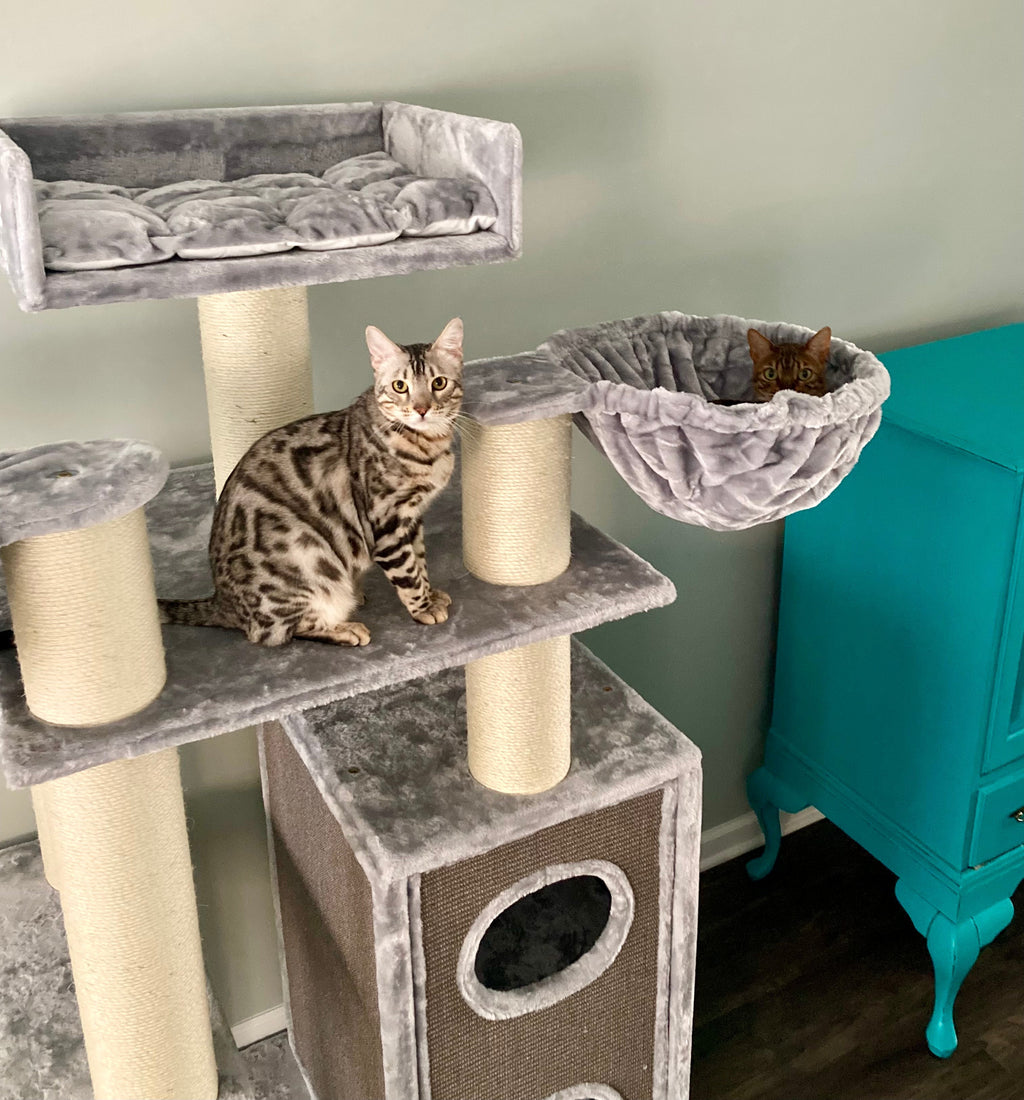
- Cat tree that reaches or exceeds the home's highest horizontal surfaces, with multiple levels to climb
- Window access at multiple heights — at least one perch at counter height or above
- Recirculating water fountain as the primary water source
- 20–30 minutes of wand play daily, ideally in two sessions (late afternoon and evening)
- Play session ending with a small meal or treat to complete the hunt-catch-eat cycle
- Toy rotation — different options daily, not the same toys left out for weeks
- At least one puzzle feeder or foraging activity per day for cognitive challenge
"Our Bengal destroyed two cheaper cat trees in eight months — she'd get to the top and the whole thing would sway. She stopped using them and started living on top of our kitchen cabinets instead. The CTK tree is the first one she actually uses the top of. It doesn't move. She's up there for hours. The counter surfing dropped by about 80% within two weeks."
Frequently Asked Questions
Why does my Bengal chirp at birds?
Chirping is a predatory motor reflex — the jaw movement mimics the kill bite a cat would deliver to prey, and the sound is a byproduct of that movement firing without a target. It's not frustration, vocalization, or a request to be let outside. It's the prey-drive circuitry activating fully in response to a target the cat can see but can't reach. Bengals chirp more intensely than most breeds because their prey drive is more intense. The best response is to follow a chirping session with a wand toy session — redirect the activated drive immediately.
How do I stop my Bengal from waking me up at 3 AM?
The 3 AM activity spike is crepuscular behavior — your Bengal's biological clock is calibrated to be active at dawn and dusk, with secondary peaks in the small hours. The most effective intervention is a 20–30 minute high-intensity play session in the evening (around 9 PM), followed immediately by a small meal or treat to trigger the hunt-catch-eat-sleep cycle. Most Bengal owners see significant improvement within 10–14 days of consistent evening play. The root cause is an unspent energy account; the fix is emptying it before bed, not managing the 3 AM expression of it.
Why does my Bengal knock things off surfaces?
Two separate behaviors are usually happening simultaneously: territorial surface investigation (Bengals need to own and map high ground) and learned attention solicitation (the cat has discovered that pushing objects produces an immediate human reaction). Punishing it rarely works because neither driver switches off under deterrent pressure. The effective response is providing higher, more interesting alternative territory — a cat tree that competes with or exceeds the counter height — and removing the attention reward by not reacting to object-pushing, while initiating interaction yourself on your terms.
Why is my Bengal obsessed with water?
Bengals descend from the Asian Leopard Cat, a riparian hunter that evolved near streams and rivers. The water fascination is direct wild heritage: moving water preference for freshness, paw-dabbing from stream-fishing behavior, and intense tactile curiosity about water's dynamic surface. It doesn't need to be managed so much as accommodated — a recirculating water fountain, supervised faucet access, and an occasional shallow water-play tray give the drive somewhere satisfying to go.
Are Bengals harder to keep than regular cats?
Bengals are not harder — they're more specific. An average domestic cat tolerates a wide range of environments with reasonable contentment. A Bengal thrives in a specific environment and deteriorates in the wrong one. Get the setup right — tall cat tree, daily high-intensity play, water fountain, toy rotation, window access — and a Bengal is an exceptionally rewarding cat. Get it wrong, and the same behaviors that make them fascinating become exhausting. The difference is almost entirely environmental, not the cat's inherent temperament.
What size cat tree does a Bengal need?
Taller than the highest horizontal surface in your home — and that's a hard minimum, not a guideline. A Bengal's territorial hierarchy is determined by height: the highest point it can reach and own is the point it will claim. If the cat tree's top platform is lower than the kitchen counter or the top of the refrigerator, the cat tree will lose the territorial competition every time. For most homes, this means a tree of at least 60–70 inches, with multiple platforms at different heights and sisal posts wide enough for the cat's full weight without swaying.
Why does my Bengal vocalize so much?
Bengals are among the most vocal of all domestic cat breeds, and their vocalizations are more varied than most — chirps, trills, yowls, chatters, and a distinctive "talking" pattern that sounds almost conversational. The increased vocalization reflects higher social intelligence and a stronger drive to communicate specific states: prey-drive activation (chirping), hunger or attention need (yowling), play-seeking (trilling), and general territorial commentary. A Bengal that vocalizes more than usual is typically signaling an unmet need — most commonly insufficient play, insufficient vertical territory, or insufficient daily engagement.
The Bottom Line
Your Bengal isn't chaotic. Your Bengal is precise. The chirp is a specific motor reflex. The 3 AM sprint is a specific biological clock. The counter surfing is a specific territorial drive. The water obsession is a specific ancestral behavior. None of it is random. All of it is readable — once you know the language.
The common thread through every decoded behavior is the same: an animal with more instinct, more intelligence, and more physical drive than the average domestic cat, living in a home that was built for the average domestic cat. Close that gap — with height, with daily play, with moving water, with the right cat tree — and the behavior doesn't disappear. It finds its appropriate channel. And a Bengal with appropriate channels is one of the most spectacular animals you can share a home with.
Decode the behavior. Build the environment.
A Bengal that counter surfs, chirps at windows, and zoomies at 3 AM is a Bengal that needs higher territory, more vertical options, and a daily play routine. Cat Tree King's tall, stable, multi-level trees are built exactly for cats like yours. Free shipping across the US.
Decode Your Cat's Behavior →