The Multi-Cat Survival Guide: What Your Cat Tree Needs to Keep Everyone Happy
Two cats, three cats, four — a multi-cat home is wonderful, chaotic, and occasionally very loud. But without the right setup, a single cat tree becomes a battleground. Here's exactly what you need to keep your furniture intact, every cat thriving, and the peace in your home.
If you share your home with more than one cat, you already know that cats are not naturally communal creatures. In the wild, they're largely solitary hunters. When you bring two or more into the same four walls, you're asking them to negotiate territory, resources, and personal space — every single day. A good cat tree doesn't just give them somewhere to scratch. It actively manages that negotiation for you.
Get it right, and the tension drops noticeably. Your furniture survives. Your cats find their rhythm. Get it wrong, and you're living inside a low-grade conflict zone with fur. This guide tells you how to get it right.
Why Cats in Groups Need More Than You Think
Most people assume that two cats will simply share everything — the food bowl, the litter box, the cat tree. And they do, eventually, sometimes, reluctantly. But the reality of feline social dynamics is more nuanced. Cats establish what behaviorists call a social hierarchy, and that hierarchy plays out most visibly around resources: food, resting spots, high vantage points, and scratching posts.
The dominant cat claims the best perch. The more anxious cat avoids the tree entirely if it means crossing the dominant cat's territory to get there. The third cat just wants to be left alone and has found a spot behind the washing machine. Sound familiar?
Research in feline behavioral science consistently shows that vertical territory is the single most important resource in a multi-cat household. A cat that can get higher than its companion immediately reduces its own stress levels — regardless of who "started it." Height equals safety, calm, and control.
The Cat Tree Hierarchy: How Your Cats Actually Use It
Understanding how cats distribute themselves vertically is the first step to designing a setup that works for everyone. In virtually every multi-cat home, a clear pattern emerges within the first few weeks of owning a cat tree:
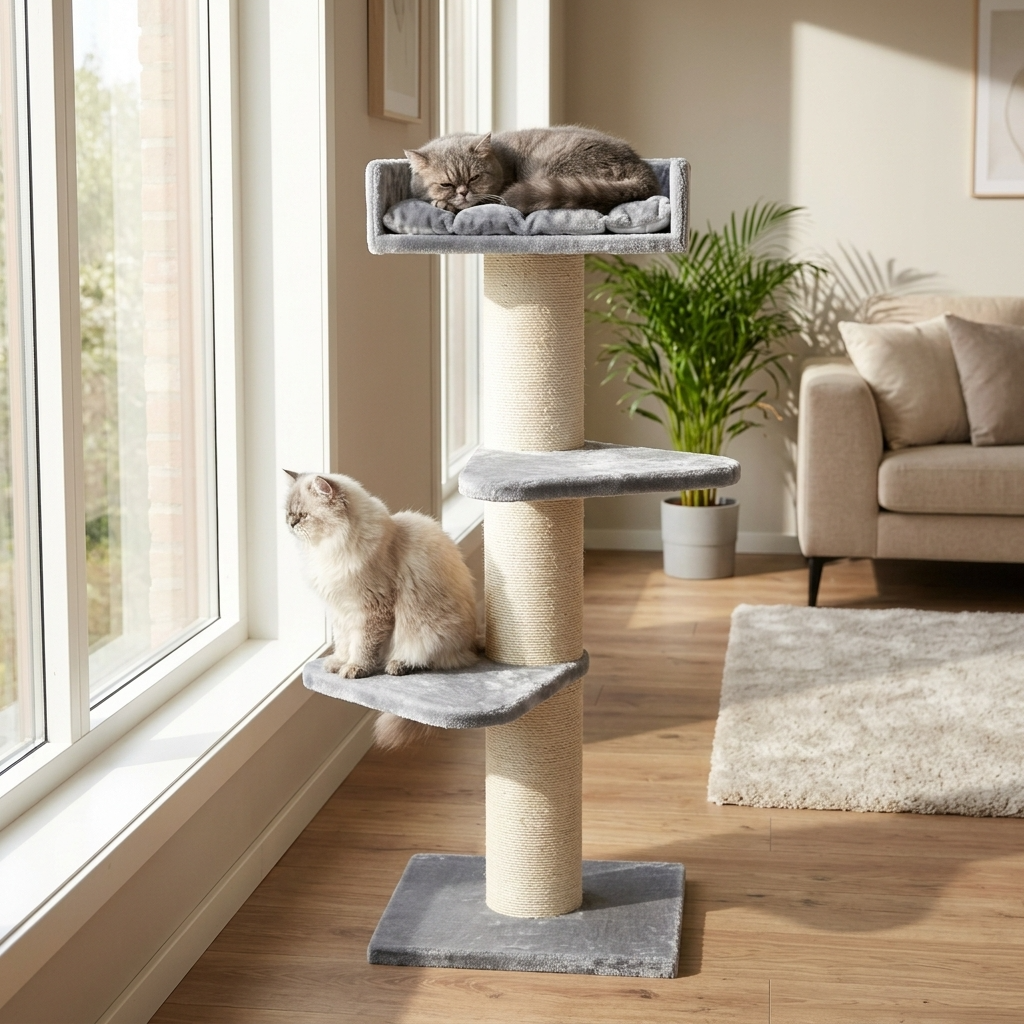
The dominant cat claims this first, every time. This is the watchtower: maximum visibility, maximum control, maximum status. A single top platform means constant competition. The fix: two separate top-level spots, ideally facing different directions.
The second cat usually settles here — high enough to feel safe, low enough to avoid confrontation with the top cat. Hammocks, enclosed boxes, and wide platforms here reduce anxiety dramatically for mid-ranking cats.
Lower areas are used for scratching and stretching — by all cats, regardless of rank. This is why you need multiple scratch posts at this level. If the only sisal post is at the base of "the alpha's territory," lower-ranking cats will scratch your sofa instead.
The most anxious cat in your household needs a space to disappear entirely. An enclosed sleeping box at mid or lower height, ideally with a single opening that faces a wall, gives nervous cats the security they need to decompress without fleeing the room.
The 5 Things Every Multi-Cat Tree Setup Must Have
These aren't nice-to-haves. Each one directly addresses a specific conflict trigger in multi-cat homes. Skip one, and you'll notice the gap in your cats' behavior within weeks.
Multiple top platforms
One throne creates one winner and one loser. Two separate high spots — even at slightly different heights — give both dominant and sub-dominant cats a "best seat" they can claim as their own. Competition drops immediately.
Enough scratching posts for everyone
The rule of thumb: one sisal post per cat, minimum. In a three-cat household, that means at least three distinct scratching surfaces — and they should be positioned so no cat has to pass another's claimed territory to reach one.
At least one enclosed hideaway
Open platforms are great for confident cats. Anxious or submissive cats need containment — a box or cave where they can see out but feel hidden. This dramatically reduces stress-related behaviors like over-grooming and house soiling.
Rock-solid structural stability
When two 12-lb cats land on a cat tree simultaneously from opposite sides, it needs to absorb that without wobbling. An unstable tree causes one cat to cede the territory permanently — which rebuilds exactly the hierarchy problem you were trying to solve.
For every resource cats compete over — litter boxes, food bowls, sleeping spots, scratching posts — the golden standard is one more than the number of cats you have. Two cats: three of everything. Three cats: four. This single rule eliminates more conflict than any behavioral intervention.
Placement: The Part Everyone Gets Wrong
You can buy the most expensive, most stable, most feature-rich cat tree on the market — and if you put it in the wrong spot, it won't work. Placement is where most multi-cat households silently fail.
The single biggest mistake
Placing one cat tree in one corner of one room. This creates a choke point: every cat in the house that wants vertical space has to navigate through the same physical zone. For the dominant cat, that's fine — it means owning the entire space. For every other cat, it means avoiding the room entirely.
The solution is to distribute vertical opportunities across multiple rooms. A tall tree in the living room. A wall-mounted shelf in the bedroom. A mid-height scratcher near the front door. Each location serves a different cat's needs and removes the "toll" that comes with sharing a single resource.
Where to position each tree
- Near a window whenever possible — outdoor movement provides mental enrichment and reduces boredom-driven conflict
- Against a wall or in a corner for stability, and so cats always have their back protected at the top
- Away from doorways and high-traffic zones — cats won't use a tree they can't approach without being startled
- Not directly next to the food bowls — eating is already a stress point; don't combine resources
- In the room where you spend most time — cats want proximity to their humans, and a tree in a rarely used room gets rarely used
"Once I put a second cat tree in the bedroom, the daily stand-offs in the living room just stopped. They divided the house between them and everyone relaxed."
How Stability Becomes a Social Issue
There's a less obvious reason structural stability matters so much in multi-cat homes — it's not just about the tree not falling over. It's about what happens to the social dynamic when it wobbles.
When a cat is using a tree and it shakes under their weight, they associate that instability with wherever they were at the time. If they were in "their" spot — the one they've claimed as safe territory — a wobble is a threat event. They may abandon that spot permanently, forcing a reshuffle of the entire hierarchy. In a multi-cat home, that reshuffle doesn't happen quietly. It happens through chasing, hissing, and three days of tension while everyone recalibrates.
If one of your cats suddenly stops using the cat tree after weeks of regular use, don't assume they've lost interest. Check whether the tree has developed any wobble — even subtle vibration on contact. A cat that's been startled by instability will avoid the tree entirely, and the resulting loss of territory will show up as aggression, spraying, or withdrawn behavior.
What "Enough Space" Actually Means Per Cat
A single mid-sized cat tree designed for one cat does not scale to two cats by simply adding one more cat. The math of multi-cat vertical space is not additive — it's multiplicative, because it's not just about total square inches of platform, it's about the number of distinct, claimable territories.
Think of it this way: a single platform that fits two cats side by side doesn't give two cats their own space. It gives them one space they have to share, which one of them will win and one will lose. Two platforms that each fit one cat comfortably give you two territories, two calmer cats, and half the conflict.
- 1 cat: Any well-built single-post tree with a comfortable top platform and one scratch post. Stability matters even for solo cats, but the complexity stops here.
- 2 cats: At minimum two claimable top-level platforms at different heights or in different rooms. Multiple sisal posts. One enclosed hideaway. Combined height of at least 150 cm.
- 3 cats: Multiple trees across at least two rooms. Three or more distinct scratch zones. Two enclosed spaces. Consider a wall-mounted cat walk system to extend vertical territory without floor footprint.
- 4+ cats: A full vertical ecosystem: large corner trees, wall-mounted shelves, dedicated scratching barrels, and ideally separate feeding stations on different levels of the home. This is a room design project, not a furniture purchase.
"I have three Maine Coons — two brothers and a female. The brothers were constantly fighting over the top of their old tree. Since getting the Corner Cat XXL, each one has claimed a different level and the aggression has basically stopped. I can't overstate how much calmer the house is now."
The Mental Health Angle: Why This Is About You Too
Living with cats that are in constant low-grade conflict is exhausting — even if you can't always identify the source. The hissing, the chasing, the territorial marking, the one cat that never comes out of the bedroom anymore. These aren't just cat problems. They raise cortisol levels in the humans in the house too. Studies on pet-owner stress consistently show that a harmonious multi-pet home produces measurably lower stress responses in the people who live there.
A properly set-up cat tree environment doesn't just serve the cats. It gives you the mental quiet of knowing every animal in your home has what they need — and that the chaos isn't your fault for not knowing what to buy. It was just the wrong tree, in the wrong spot, for the wrong number of cats. That's a solvable problem.
A 2022 study by the University of Lincoln found that cats in households with adequate vertical territory showed 40% fewer stress indicators — including reduced hiding, less inter-cat aggression, and lower rates of inappropriate elimination. The same study found that owner-reported stress scores dropped significantly in parallel.
Built for multi-cat households. Proven by them too.
Cat Tree King's range includes extra-wide platforms, multiple sleeping zones, and the structural integrity to handle two or three cats using the tree simultaneously — without a single wobble. Over 7,000 verified reviews from real multi-cat households.
Find Your Multi-Cat Setup →Quick Checklist: Is Your Setup Multi-Cat Ready?
- Only one cat uses the tree — the others avoid it
- You observe one cat blocking another's access to the tree
- The tree wobbles or tips when two cats use it at once
- There's only one top platform — and daily battles for it
- All your cat furniture is in one room
- No enclosed hideaway space anywhere in the house
- Scratch posts are positioned inside a dominant cat's claimed zone
- Each cat has a claimed spot they return to consistently
- Cats can access the tree from different angles without crossing each other
- You have vertical options in at least two rooms
- The most anxious cat has an enclosed space of their own
- The tree doesn't move, shake, or tip under simultaneous use
- Scratch behavior happens on the posts, not your furniture
- Inter-cat tension is low — or you've watched it noticeably decrease
Frequently Asked Questions
How many cat trees do I need for two cats?
At minimum, one large tree with at least two distinct high platforms and multiple scratch posts. Ideally, one tree in the main living space plus a secondary scratching post or wall shelf in another room. The goal is to ensure neither cat has to pass through the other's claimed territory to access vertical space.
Why does only one of my cats use the cat tree?
Almost always, this means the dominant cat has claimed the tree as its territory and the other cat is avoiding conflict by staying away. The solution is not behavioral training — it's adding a second distinct vertical option positioned away from the dominant cat's zone, so the other cat has somewhere to go that doesn't require a confrontation.
My cats fight near the cat tree. What's causing it?
Fighting near the cat tree is almost always a resource-competition response — there aren't enough distinct claimable spots for the number of cats competing. The fix is more platforms, not behavior correction. Add a second tree or wall-mounted perch at a different height in a different location, and the conflict typically resolves within days.
Do cats need their own separate cat trees?
Not necessarily — but they do need their own distinct, claimable spots within whatever tree setup you have. A single large corner tree with four or five separate platforms can serve three cats comfortably, as long as each cat can claim and retreat to their spot without having to navigate through another cat's zone to get there.
Where is the best place to put a cat tree in a multi-cat home?
Near a window in the room where you spend the most time — cats want proximity to their humans and outdoor visual stimulation. In a multi-cat home, distributing trees across multiple rooms is more important than the specific spot within any one room. Avoid positioning trees as dead-ends that require passing through another cat's territory to exit.
Can a wobbly cat tree cause behavioral problems in multi-cat homes?
Yes — and it's more common than people realize. When a cat is startled by instability at their claimed spot, they may abandon that territory permanently. In a multi-cat home, one cat losing its spot triggers a hierarchy reshuffle that can produce days of tension, chasing, and stress behaviors. Structural stability is a behavioral issue, not just a safety one.
What features should I look for in a cat tree for multiple cats?
In order of importance: multiple distinct top-level platforms, at least one enclosed sleeping box, multiple sisal scratching posts, a wide and heavy base that doesn't move under simultaneous use, and strong M8 or M10 bolt connections throughout. Replaceable sisal parts are a bonus — in a multi-cat home, wear happens faster.
The Bottom Line
A multi-cat household works beautifully — when the environment is designed for it. The cats don't need to become best friends. They need a setup where each of them can claim space, avoid confrontation, scratch without negotiating, and rest without being watched. Give them that, and the harmony follows. Often faster than you'd expect.
The cat tree isn't a luxury in a multi-cat home. It's the piece of infrastructure that holds the social structure together. Choose one that's built for it.
Designed for homes where cats outnumber humans.
Explore our full collection — including extra-wide platforms, corner trees with multiple levels, and cat climbing walls that extend vertical territory room to room. Free shipping. Built to last.
Shop Multi-Cat Solutions →