Why Regular Cat Trees Are No Match for a Maine Coon
The Maine Coon isn't just big — it's a powerful, muscular athlete that will destroy a standard scratching post in a matter of months. Here's exactly why, and what you actually need.
Have you ever watched your Maine Coon charge confidently at a brand-new scratching post — only to see the whole thing wobble, tilt, and slowly give up? Or found yourself propping it back up every day because it just won't stay put? You're not alone. Maine Coon owners everywhere know this story: the post didn't break. It just lost.
To understand why, you need to know what a Maine Coon is actually capable of physically. And the answer is quite a lot more than most people expect.
The Raw Strength of a Maine Coon — By the Numbers
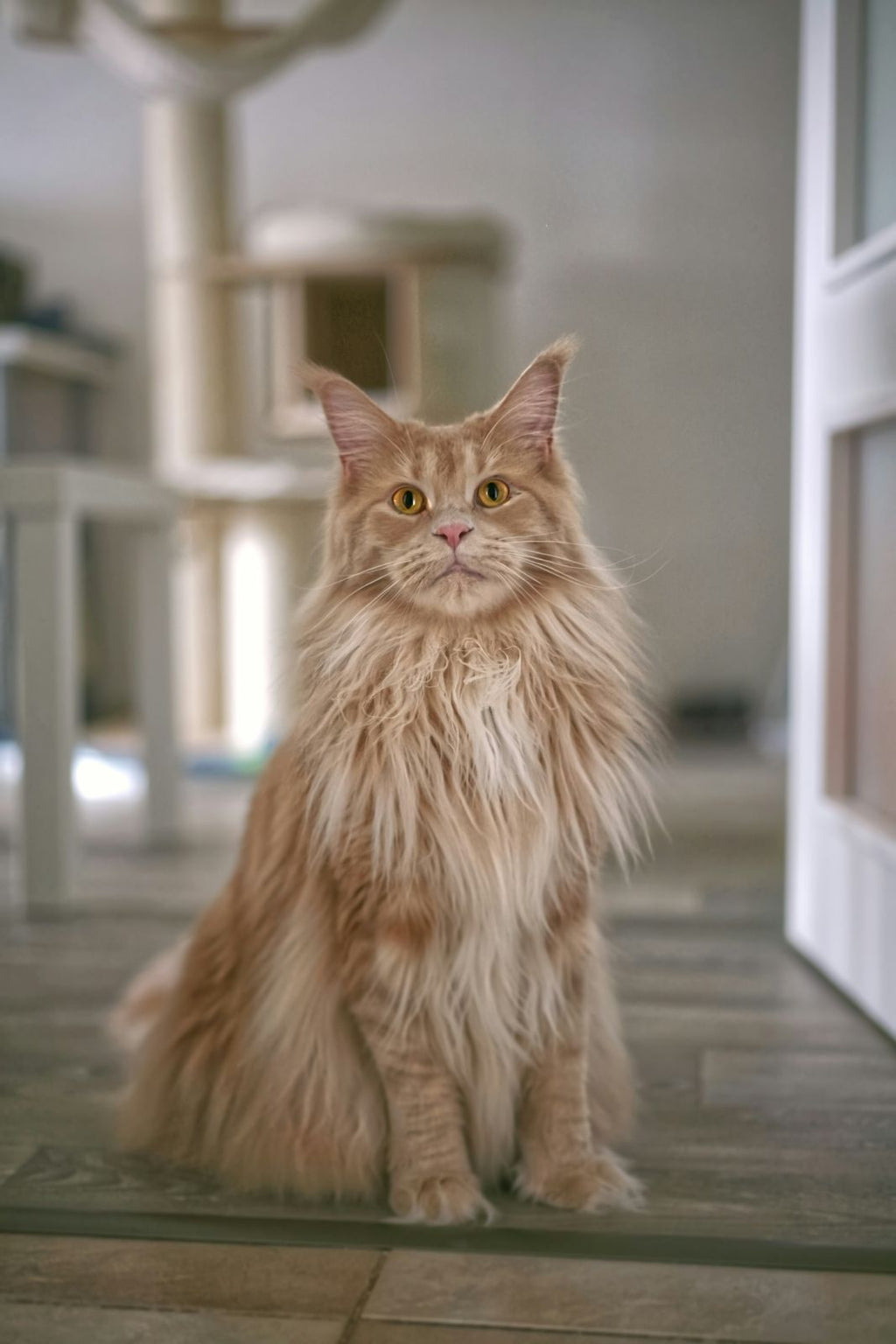
The Maine Coon is the largest registered domestic cat breed in the world. Males typically weigh between 15 and 22 lbs — exceptional individuals tip the scale at 25 lbs or more. But weight alone doesn't tell the full story. What makes the Maine Coon exceptional is the combination of mass, dense muscle, and a deep-seated hunting instinct that drives its everyday behavior.
The breed descends from rugged working farm cats in the harsh climate of Maine. That evolutionary background gave them a powerfully muscled, compact body with particularly strong hindquarters — the kind of frame built for moving through deep snow and taking down substantial prey. That strength is still very much present today, even if your Maine Coon's main territory is your living room couch.
During a standing jump, a 20 lb Maine Coon can generate an impact force exceeding 330 Newtons at the landing point — roughly equivalent to a grown adult striking a surface with a closed fist. Any scratching post not structurally engineered for that kind of dynamic load will wobble, tip, or eventually fail.
What Actually Happens When a Maine Coon Jumps
When a Maine Coon decides to leap onto a cat tree, it's not a gentle hop. The hindquarters fire with a powerful push, the body extends fully, and at the landing the entire weight transfers abruptly to whatever platform or post is at the destination — usually something anchored by a single thin bolt or bracket in most budget cat trees.
That moment of landing is the critical point. An average house cat at 9 lbs lands with little impact. A 20 lb Maine Coon dropping from 4 feet up temporarily multiplies its effective weight two to three times through deceleration. That's more than 400 Newtons delivered to a single point in a fraction of a second.
"My Maine Coon and his cat tree fell over together. He jumped on it, and the whole thing went down with him."
Scratching Isn't a Chore — It's a Full Workout
Beyond dramatic jumps, the everyday act of scratching is itself a serious structural test. Cats don't scratch just to sharpen their claws — they also stretch their spine, activate their shoulder muscles, and practice full-body control. For a Maine Coon approaching 20 lbs, that means using its entire body weight as downward pulling force.
During a scratch, a Maine Coon places its front paws high on the post and drags downward with everything it's got. If the base isn't heavy enough to act as a counterweight — which is the case with most standard models — the post rocks forward on the very first serious scratch. Repeat this hundreds of times a week, and even reinforced attachment points wear out.
A cat tree that tips while your Maine Coon is on top isn't just a nuisance — it can be dangerous. Falls from unstable structures can cause injury, and the experience can lead to anxiety and behavioral problems. Make sure the post can handle your cat before you install it, not after it's already collapsed.
The Four Reasons Standard Cat Trees Fail
1. Posts That Are Too Narrow
Most cat trees sold in pet stores or online come with sisal posts around 3 to 4 inches in diameter. That's adequate for an average-sized house cat. For a Maine Coon, it's barely a warm-up. The force applied to a narrow post during scratching or climbing creates stress fractures in the sisal wrap that spread rapidly.
2. A Base That's Too Light
More than half of a cat tree's stability comes from the weight and footprint of its base. A cat tree that weighs 10 lbs with a 14-inch square base simply has no counterweight against a cat pulling at 20 lbs of force. Physics wins every time.
3. Poor Sisal Attachment
Budget models use stapled or loosely glued sisal that isn't anchored consistently from top to bottom. A Maine Coon pulling at the upper section unravels the wrap from the first scratch. Within weeks — not months — the sisal is already peeling.
4. Not Engineered for Impact
Platforms and lounging areas in standard cat trees are rated for a static weight of around 10 to 13 lbs. A Maine Coon jumping generates dynamic forces far beyond that. Platforms flex, bolts loosen, and the entire structure starts swaying after repeated impact loads.
- Thin sisal posts unravel within weeks of serious use
- Lightweight base tips over from pulling or jumping force
- Platforms flex and sag under the cat's weight at landing
- Bolt connections loosen after repeated impact
- Entire structure wobbles once the cat climbs to the top
"We have two large CTK trees we purchased a few years ago and are still in incredible condition in spite of what our Maine Coons can toss at them! My three Maine Coons had destroyed every other scratching post in months. This one is rock solid — they scratch, climb, and jump on it daily and it doesn't move an inch."
What a Maine Coon Cat Tree Actually Needs
Now that you know what goes wrong, the question is: what works? A cat tree that holds up against a Maine Coon isn't a standard cat tree with a slightly bigger base. It's a structure engineered specifically for weight, force, and repeated impact.
- Sisal posts at least 8 inches (20 cm) in diameter for genuine stability
- Sisal fully glued from top to bottom — no staples, no loose edges
- A heavy base with sufficient surface area to act as a counterweight
- Minimum M8 or M10 bolt connections for rock-solid joints throughout
- Platforms rated for dynamic weight, not just static load
- Replaceable parts: when sisal wears out, swap the post — not the entire tree
Built for Maine Coons. Tested by Maine Coons.
At Cat Tree King, we engineer cat trees that can handle the strength of large breeds. Thick sisal posts, extra-heavy bases, M10 bolt connections — and over 7,000 five-star reviews from owners who've been there.
Shop the Collection →How Fast Does It Fall Apart? A Realistic Timeline
Based on experiences shared by Maine Coon owners and verified customer reviews, here's how a typical standard cat tree performs under daily use:
Everything looks fine. The cat uses the post, the sisal is still tightly wrapped, the base stays put. But microscopic stress points are already forming inside the structure.
Sisal begins rolling loose along the top edges. The cat instinctively scratches lower where the wrap is still firm. The bolt joints start to vibrate slightly after each jump.
The post visibly shakes when the cat scratches. The base tips forward during jumps. Some owners start wedging books against it or securing it to the wall with tape.
The sisal is hanging in strips. The post leans. The cat avoids it entirely — and starts going for the sofa instead.
Buy a new cat tree. Start the cycle over. Maine Coon owners go through two to three standard posts per year — spending more in the long run than one well-built tree that lasts a decade.
Maine Coon owners spend an average of $150–$250 per year replacing cheap scratching posts. Over five years, that's more than the cost of one well-engineered cat tree with replaceable sisal posts that lasts a decade or more.
Frequently Asked Questions
How high can a Maine Coon jump?
A healthy adult Maine Coon can jump up to 5–6 feet from a standstill. With a running start, they can cover 12 to 15 feet horizontally. This makes a stable, well-anchored landing platform on any cat tree absolutely essential for their safety.
How much force does a Maine Coon apply when scratching?
When scratching, a 20 lb Maine Coon applies downward pulling force roughly equal to its own body weight — around 90 Newtons of sustained load on the sisal post. Combined with jump-landing peaks, total force can exceed 400 Newtons in short bursts.
How long does a regular cat tree last with a Maine Coon?
Most standard cat trees hold up for 3 to 6 months under active Maine Coon use before the sisal comes loose or the structure becomes unstable. Some cheaper models give out within 4 to 6 weeks of heavy daily scratching and climbing.
Why does my cat tree tip over when my Maine Coon scratches it?
The post tips because it isn't heavy enough to resist the pulling force. When a Maine Coon scratches, it drags its full body weight downward — if the base is lighter than the cat, the cat wins. The fix is a cat tree with a substantially heavier base and wider footprint, specifically designed for large-breed cats.
What is the best cat tree for a Maine Coon?
Look for sisal posts at least 8 inches in diameter, fully bonded sisal (no staples), heavy-duty M8 or M10 bolt connections, and a wide, heavy base. At Cat Tree King, the Maine Coon Sleeper, Tiger series, and Corner Cat XXL are among the most popular models with large-breed owners.
Can I replace the sisal when it wears out?
With most standard models, no — you buy an entirely new post. At Cat Tree King, every sisal pole and structural part is available individually as a spare. When the sisal wears down, you simply swap the post. The frame keeps going for years.
Bottom Line: Buy Right the First Time
A Maine Coon is not a regular cat, and its cat tree shouldn't be either. The combination of impressive weight, explosive jumping power, and the instinct to scratch with its entire body makes this breed an impossible challenge for off-the-shelf cat furniture.
The good news is the solution is straightforward. A cat tree built for large breeds — with thick posts, a heavy base, industrial bolt connections, and replaceable parts — doesn't last months. It lasts years. Often a lifetime.
At Cat Tree King, we've been building cat trees with exactly those principles since 2002. Designed and tested in Belgium, trusted by Maine Coon owners across the US and beyond.
Ready for a Cat Tree That Can Actually Handle Your Maine Coon?
Explore our full collection — selected and reviewed by owners of Maine Coons, Ragdolls, and other large breeds. Free shipping on all orders.
Shop Cat Trees →